World Cup 2026 Streaming Guides & News

Why IPTV Is the Best Option for Watching World Cup 2026
World Cup 2026 Streaming Guides & News

Why IPTV Is the Best Option for Watching World Cup 2026 Abroad

For millions of football fans, the 2026 World Cup is a “bucket list” event. However, for those living abroad—whether you are an expat in Europe, a digital nomad in Southeast Asia, or a traveler on a business trip in the Middle East—watching the tournament can be a logistical nightmare. Regional broadcasting rights often mean your favorite commentators are blocked, and local cable packages are both expensive and difficult to cancel. In 2026, **Internet Protocol Television (IPTV)** has emerged as the definitive solution for the global fan. It bypasses the traditional limitations of geography and hardware, providing a “borderless” viewing experience. This 1,600+ word educational guide explores why IPTV is technically superior for watching the World Cup abroad and how to optimize your setup for international travel. 1. Bypassing “Geo-Blocks” with Global Access Broadcasting rights for the World Cup are sold on a country-by-country basis. If you are a British expat in Spain, you may find that local Spanish broadcasters have exclusive rights, meaning you cannot access the BBC iPlayer or ITVX without facing a “Not available in your region” error. IPTV solves this through **Global Channel Aggregation**. A premium IPTV service in 2026 doesn’t just give you local channels; it gives you the “Master Feed” for hundreds of countries. The Benefit: You can watch the England match with BBC commentary, the Brazil match with Globo coverage, or the USA match via FOX, regardless of which country you are currently standing in. Technical Note: Because IPTV streams over the internet (IP), it doesn’t rely on a physical satellite footprint. As long as you have an internet connection, you have access to your home country’s specific broadcast style and language. 2. Cost Efficiency for Short-Term Stays Traditional cable and satellite providers in most countries require long-term contracts (often 12 to 24 months) and professional installation. For an expat on a 6-month contract or a traveler staying for the duration of the tournament, this is financially impossible. Feature Local Foreign Cable Premium IPTV Abroad Contract 12-24 Months (Standard) Month-to-Month (Flexible) Installation Required (Box + Dish/Cable) Zero (App-based) Portability Fixed to one address Works on Phone, Laptop, & Hotel TV Average Cost $80 – $120 / month $15 – $25 / month Educational Insight: For the price of one month of traditional cable in a foreign country, you can often secure an entire year of IPTV, covering the World Cup and every other major sporting event in 2026. 3. The Power of “Catch-Up” for Different Time Zones The World Cup 2026 is hosted in North America. This creates a significant “Time Zone Gap” for fans in Europe, Africa, and Asia. A match kicking off at 8:00 PM in Los Angeles will be 4:00 AM in London and 7:00 AM in Dubai. Catch-Up TV is the expat’s best friend. Premium IPTV services in 2026 record the matches on their servers automatically. You don’t need to leave your device on overnight to “record” the game. You can simply wake up, scroll back in your TV guide to the 4:00 AM slot, and hit play. This “time-shifting” technology ensures you never have to choose between your sleep and your team. 4. Multi-Language Commentary: Feeling at Home For an expat, hearing the match in your native language is part of the emotional experience. Watching the World Cup with local foreign commentary can feel isolating. IPTV allows you to choose your experience. Arabic Fans: Access beIN Sports from anywhere. Spanish/Latin Fans: Access Telemundo or TyC Sports. French Fans: Access TF1 or Canal+. This variety ensures you get the cultural nuances, the hometown bias, and the specific analysis you grew up with, which is something a local foreign broadcaster can never provide. 5. Optimization: The Role of VPNs for Travelers When you are abroad, your “Digital Identity” (IP Address) changes. Some IPTV providers use IP Locking for security, which can prevent your service from working when you move to a new country. Furthermore, hotel Wi-Fi networks often block “Streaming” ports to save bandwidth. Using a VPN with IPTV in 2026: A VPN (Virtual Private Network) is an essential tool for the traveler. It creates an encrypted tunnel between your device and a server in your home country. Bypass Hotel Restrictions: The VPN masks your traffic, so the hotel router cannot tell you are streaming 4K video. Maintain “Home” Access: By connecting to a VPN server in your home city, you appear to your IPTV provider as if you never left home, preventing security flags. Prevent ISP Throttling: Many international ISPs (especially in developing regions) intentionally slow down international video traffic. A VPN encrypts these packets, preventing the ISP from identifying and slowing your World Cup stream. 6. Hardware Portability: Your Stadium in a Suitcase Traditional TV requires a box and a screen. For the traveler, your “box” is a Firestick, a Laptop, or even your Smartphone. Modern IPTV players like TiviMate or IPTV Smarters Pro are designed to be lightweight. You can plug a Firestick into any hotel TV HDMI port, connect to the Wi-Fi (plus your VPN), and within two minutes, you have a 4K sports bar in your hotel room. This level of portability is what makes IPTV the superior choice for the 2026 tournament. 7. Technical Readiness: Dealing with “Public Wi-Fi” Jitter Public Wi-Fi in airports or hotels is notoriously unstable. This causes **Jitter**, which leads to buffering. To avoid this while abroad, follow these technical education steps: Increase Buffer Size: In your IPTV app settings, set the buffer to 4 or 5 seconds. This creates a larger “reservoir” of video, so if the hotel Wi-Fi dips for a second, the match keeps playing. Use a Travel Router: Devices like the GL.iNet Slate AX allow you to connect to the hotel Wi-Fi and then broadcast your own private, secured, and VPN-enabled network to all your devices. Lower Resolution if Necessary: On a laptop or phone screen, the difference between 4K and 1080p is small. If you are on a weak international connection, lowering the quality to
Common IPTV Problems During World Cup 2026
World Cup 2026 Streaming Guides & News

Common IPTV Problems During World Cup 2026: Solutions for Match Day

The 2026 World Cup is a period of immense traffic for global streaming servers. Even with a premium service, the sheer volume of simultaneous 4K requests can lead to technical hiccups. When you are moments away from a kickoff, you don’t have time for long support tickets; you need immediate, technical solutions. This educational guide breaks down the four most common IPTV failures—app crashes, channel downtime, EPG errors, and login failures—and provides the professional “quick-fixes” to get you back into the game before the next whistle. 1. The App Crash: “Force Close” and Memory Management During a high-bitrate live broadcast, your streaming device (Firestick, Shield, or Smart TV) is working at its thermal limit. If the app suddenly freezes or kicks you back to the home screen, it is usually due to a RAM Overflow or a Cache Conflict. How to Fix It: Clear the App Cache: Go to your device Settings > Apps > [Your Player App] > Clear Cache. This deletes temporary files that may have become corrupted during the stream. Force Stop Background Apps: Use a “Background Apps” manager or manually stop apps like YouTube, Netflix, or Spotify. These consume RAM that your IPTV player needs for the 4K buffer. The 60-Second Hard Reset: Unplug your streaming device from the power source for a full minute. This clears the system memory (RAM) and resets the hardware’s internal clock. 2. Channel Down: “404” or “Black Screen” If your primary channel goes dark right as the anthem starts, don’t panic. In 2026, most World Cup providers use Dynamic Linking. This means they can move the stream to a new server to avoid a takedown or a crash. Technical Troubleshooting: The “Update Playlist” Command: Go to your app settings and click “Update Playlist” or “Refresh Content.” This forces the app to pull the newest, working URLs from the provider’s server. Switch the Video Decoder: Sometimes the “Hardware” decoder fails on a specific stream. Go to Settings > Player > Decoder and switch to “Software” or “Native.” While this uses more CPU, it often brings a “dead” channel back to life. The Alternate Feed Strategy: Every World Cup match is broadcast by dozens of countries. If “USA – FOX” is down, try the UK (BBC), Canada (TSN), or an Arabic feed (beIN). The match is the same; only the commentary changes. 3. EPG Issues: “No Information” or Incorrect Times An Electronic Program Guide (EPG) that shows the wrong match time or simply says “No Information” makes it impossible to use features like Catch-Up or Recording. How to Fix EPG Errors: Time Zone Offset: Go to Settings > EPG > EPG Timeshift. If the match says it starts at 4 PM but it’s actually 2 PM, adjust the offset by -2.0. This fixes the alignment without needing a server update. Clear EPG Data: Sometimes the guide data gets “stale.” Find the “Clear EPG” button in your settings, then click “Update EPG.” This wipes the old database and downloads a fresh schedule. Check the “tvg-id”: If you are a pro user editing your own M3U, ensure the tvg-id in your file matches the ID in the EPG source. A single missing letter will result in “No Information.” 4. Login Errors: 401, 403, and Server Connection Failed Login errors usually happen when the provider’s “Handshake Server” is under heavy load. However, it can also be a sign of an ISP Block. Error Code The Fix 401 Unauthorized Check for typos or an expired subscription. Try logging in on a second device to verify. 403 Forbidden This is usually an ISP block. Turn on your VPN immediately to mask your traffic. Server Connection Failed Reboot your router. Your IP might be temporarily “soft-banned” for too many refresh requests. 5. Preventing the “Match Day” Disaster The best way to fix a problem is to prevent it. Follow this educational “Pre-Flight” checklist 1 hour before the World Cup kickoff: Verify VPN: Ensure your VPN is connected to a “Streaming Optimized” server near your location. Update App: Ensure you are using the latest 2026 version of TiviMate or Smarters. Check Ethernet: Unplug and replug your Ethernet cable to ensure a solid physical connection. Refresh Guide: Perform a manual EPG update to see the latest knockout-stage match times. Conclusion Technical issues during the 2026 World Cup are often the result of unprecedented global demand. By understanding the basics of Cache Management, Decoder Switching, and DNS/VPN usage, you can troubleshoot 99% of common problems in under two minutes. Preparation is the difference between watching the goal and staring at a loading screen. Secure your setup, know your error codes, and enjoy the tournament.

World Cup 2026 Match Schedule
World Cup 2026 Streaming Guides & News

World Cup 2026 Match Schedule and How to Watch Every Game on IPTV

The FIFA World Cup 2026 is officially here, and it is making history as the largest edition ever. For the first time, 48 nations are competing in 104 matches across 16 host cities in the United States, Canada, and Mexico. With games spread across multiple time zones and three massive countries, staying organized is the only way to ensure you don’t miss a single goal. In 2026, the traditional “cable bundle” has been replaced by more flexible, high-performance streaming solutions. This educational guide provides the essential match schedule for the tournament and a technical roadmap on how to use IPTV to access every broadcast, from the opening whistle in Mexico City to the grand final in New York/New Jersey. 1. Key Dates and Tournament Structure The 2026 tournament follows a new, expanded format. Teams are divided into 12 groups of four. The top two from each group, along with the eight best third-place finishers, will advance to the brand-new Round of 32. Group Stage: June 11 – June 27, 2026 Round of 32: June 28 – July 3, 2026 Round of 16: July 4 – July 7, 2026 Quarter-finals: July 9 – July 11, 2026 Semi-finals: July 14 – July 15, 2026 Third-place Play-off: July 18, 2026 The Final: July 19, 2026 (MetLife Stadium, East Rutherford) 2. World Cup 2026 Match Schedule: High-Profile Fixtures While the full schedule contains 104 matches, several marquee encounters and host-nation games are the primary focus for global audiences. Below are the confirmed details for the opening rounds: Date (2026) Fixture Venue / City Group June 11 Mexico vs. South Africa (Opener) Estadio Azteca, Mexico City Group A June 12 USA vs. Paraguay SoFi Stadium, Los Angeles Group D June 12 Canada vs. Italy/Wales Playoff Winner BMO Field, Toronto Group B June 13 Brazil vs. Morocco MetLife Stadium, NY/NJ Group C June 17 England vs. Croatia AT&T Stadium, Dallas Group L June 19 USA vs. Australia Lumen Field, Seattle Group D 3. How to Watch the World Cup 2026 via IPTV IPTV (Internet Protocol Television) is the most efficient way to access international broadcasts during the World Cup. Because the tournament is global, different broadcasters provide varying levels of analysis, commentary, and visual quality. To watch every game, you need to know which channels to target within your IPTV player. Primary Channels for English Commentary: USA: FOX and FS1 (English), Telemundo and Universo (Spanish). United Kingdom: BBC One and ITV1. Matches are shared between these two broadcasters, with both offering high-quality 4K UHD streams on their digital platforms (iPlayer and ITVX). Canada: TSN and CTV. Australia: SBS (which traditionally offers free-to-air coverage for every match). International Feeds for Tactical Variety: One of the best features of IPTV is accessing feeds from a team’s home country. In 2026, many fans are choosing to watch matches on beIN Sports (MENA) for their world-class studio analysis or TF1 (France) and ARD/ZDF (Germany) for deep tactical breakdowns. 4. Technical Optimization for the 104-Match Marathon The 2026 World Cup is a “marathon” of data. To ensure your IPTV setup doesn’t fail during the knockout rounds, follow these technical education steps: A. Managing Multiple Streams During the final group stage matches (June 24–27), games in the same group are played simultaneously to prevent collusion. To watch both at once, you need an IPTV app that supports Multi-screen (Picture-in-Picture). We recommend using TiviMate Premium on a device with at least 3GB of RAM, such as the NVIDIA Shield Pro, to handle two 4K streams side-by-side. B. Beating the “Time Zone” Challenge with Catch-Up With matches taking place across the North American continent, kick-off times will vary wildly for international viewers. If a match kicks off at 3:00 AM your time, ensure your IPTV provider offers 7-Day Catch-Up. This allows you to wake up and play the full match recording directly from your TV guide without needing to set a manual recording. C. Network Stability for 4K Live Sports Live 4K sports streaming requires a consistent 25-30 Mbps download speed. In 2026, the most reliable setup is to Hardwire your device via Ethernet. Wi-Fi signals—even Wi-Fi 7—can experience “packet loss” during high-traffic events, which leads to buffering right at the moment of a goal. 5. Avoiding ISP Throttling During Peak Matches During massive global events like the World Cup, Internet Service Providers often experience heavy load. To protect their network, they may “throttle” (slow down) high-bandwidth video traffic. Conclusion: Your Passport to the 2026 World Cup The 2026 World Cup is a celebration of the beautiful game on an unprecedented scale. By combining the official match schedule with a professional IPTV setup, you move from being a casual viewer to having a front-row seat to history. Whether you are following your national team or tracking every underdog story across the 16 host cities, the flexibility and quality of IPTV ensure you are part of the global audience. Test your setup today, verify your channel list, and prepare your network. The world is coming to North America—make sure you’re ready to watch it all.

How to Avoid Buffering During World Cup 2026
World Cup 2026 Streaming Guides & News

How to Avoid Buffering During World Cup 2026 IPTV Streams

The 2026 World Cup is set to be a monumental event, with 48 teams competing across North America. For many fans, IPTV is the preferred method for catching every game in high definition. However, the most significant hurdle to a perfect viewing experience is the dreaded buffering. In a live sports environment, where every second counts, a freeze in the stream can mean missing a historic goal. Buffering is rarely caused by just one factor; it is usually a combination of network latency, hardware limitations, and provider server load. This 1,500+ word educational guide provides a deep-dive into the technical strategies required to eliminate lag and ensure a seamless 4K experience for the entire 2026 tournament. 1. The Science of the “Buffer”: Why Your Stream Stutters In simple terms, buffering occurs when your IPTV player runs out of video data to play. Your device “requests” packets of data from the server, stores them in a temporary cache (the buffer), and then plays them. If the data arrives slower than the playback speed, the video stops to wait for more packets. During a global event like the World Cup, the “pipes” of the internet become congested. To avoid this, you must optimize every link in the chain: your Internet Connection, your Router, your VPN, and your Streaming Device. 2. Infrastructure First: The Ethernet Commandment If you are serious about avoiding buffering during the World Cup, the first rule is: Abandon Wi-Fi. Even the most advanced Wi-Fi 7 routers are subject to “interference” and “jitter.” Every time a neighbor uses a microwave or a nearby router switches channels, your wireless signal “drops” for a millisecond, causing a 5-second buffer on a 4K stream. Hardwire with Cat6/Cat7: A physical Ethernet cable provides a shielded, dedicated lane for your data. It ensures a consistent “Ping” (latency), which is the most critical factor for live video. Powerline Adapters: If your router is in another room, use Powerline Adapters. These send the internet signal through your home’s electrical wiring, which is significantly more stable than Wi-Fi for IPTV. 3. ISP Throttling and the VPN Solution In 2026, many Internet Service Providers (ISPs) use **Deep Packet Inspection (DPI)**. When they detect a high-bandwidth stream coming from an IPTV server during a live World Cup match, they may “throttle” your speed to prevent their network from slowing down for other users. This is called “targeted throttling.” How a VPN Fixes Buffering: A high-quality VPN encrypts your traffic. To your ISP, your data looks like a secure work-from-home connection or standard encrypted web traffic. Because they cannot see it is an IPTV stream, their automated throttling systems aren’t triggered. Note: Always use the WireGuard protocol in 2026. It is 30% faster than OpenVPN and adds almost no “overhead” to your connection, ensuring your 4K bitrate remains high. 4. Optimizing Your IPTV Player Settings The software you use, such as TiviMate or IPTV Smarters Pro, has hidden settings that can significantly reduce buffering. Most users leave these at “Default,” which is a mistake for high-bitrate live sports. Adjusting the “Buffer Size”: Go to your app settings and look for “Buffer Size” or “Network Caching.” Fiber Internet (100Mbps+): Set the buffer to “None” or “0.5 seconds.” This keeps you as close to live as possible. Standard Internet/Wi-Fi: Set the buffer to “2 to 4 seconds.” This creates a larger “safety net” of pre-loaded video to cover minor speed dips. Hardware Decoding: Ensure your app is set to use Hardware Decoding. This offloads the video processing to the dedicated chip in your device (like the Firestick or NVIDIA Shield), preventing the CPU from overheating and causing “system-level” lag that looks like buffering. 5. The DNS Secret for Faster Handshakes Every time you change a channel, your device has to “look up” the server address. If you use your ISP’s default DNS, this process can be slow. During the World Cup, a slow DNS can cause a 10-second delay when you switch from one game to another. The Fix: Manually change your DNS in your router or device settings to: Primary: 1.1.1.1 (Cloudflare) Secondary: 8.8.8.8 (Google) 6. Hardware Performance: Is Your Device the Bottleneck? 4K HDR video at 60 FPS is extremely resource-heavy. If you are using an old “Smart TV” app or a generic, cheap Android box, the hardware itself may be the reason for the buffering. The device simply cannot “unpack” the data as fast as it arrives. Device Level Recommended For World Cup Buffering Risk Smart TV App General viewing only High (Weak processors) Firestick 4K Max Strong Mid-range Low (with Ethernet) NVIDIA Shield Pro The “Gold Standard” Very Low (Best cooling) 7. Troubleshooting Server-Side Congestion Sometimes, the buffering isn’t your fault—it’s the provider’s. During the World Cup 2026, premium providers use Load Balancers. If one channel is buffering, try an “Alternative” feed of the same match. For example, if the “USA – FOX” channel is lagging, switch to the “UK – BBC” or “MENA – beIN” feed. Often, those servers are less crowded. 8. The “Match Day” Maintenance Routine To ensure a flawless experience, we recommend this 5-minute routine before every major match: Restart Your Router: This clears the internal cache and resets your connection to the ISP. Clear App Cache: Go to your device settings > Apps > IPTV Player > Clear Cache. This prevents “stale data” from slowing down the app. Check for Updates: Ensure your IPTV app and your VPN are running the latest 2026 versions for maximum compatibility. Conclusion: Preparation Wins the Game Avoiding buffering for the 2026 World Cup is about removing every possible point of failure. By hardwiring your connection, using a modern VPN protocol, and optimizing your app’s buffer settings, you create a robust environment that can handle even the most data-intensive 4K broadcasts. Take the time to set up your system today, so when the opening whistle blows in 2026, you can focus on the goals, not the loading circle.

Best IPTV Features You Need for World Cup 2026
World Cup 2026 Streaming Guides & News

Best IPTV Features You Need for World Cup 2026 Streaming

The 2026 FIFA World Cup is more than just a sports tournament; it is a global phenomenon that represents the pinnacle of human athletic achievement and national pride. For fans, it is also a massive technological event. With 48 teams competing across three nations—the USA, Canada, and Mexico—the demand for high-quality, reliable, and flexible viewing options is higher than ever before in history. In this landscape, Internet Protocol Television (IPTV) has transitioned from a niche alternative to the primary way millions of enthusiasts consume live sports. However, the quality of your experience depends entirely on the technical features of your service. Simply “having access” to a channel is no longer enough when the standard is 4K resolution and zero-latency performance. This 1,500+ word educational guide explores the essential IPTV features you need to guarantee a stadium-like experience for every minute of the 2026 World Cup. 1. The Foundation of Quality: Native 4K UHD and 60 FPS In 2026, the visual standard for sports is 4K Ultra High Definition (UHD). However, there is a significant educational distinction between “Upscaled 4K” and “Native 4K.” Native 4K Resolution Native 4K implies that the signal is captured, transmitted, and delivered to your screen at a resolution of 3840 x 2160 pixels. Many lower-tier providers take a 1080p Full HD signal and use software to “stretch” it to 4K. This results in a soft, blurry image. For the World Cup 2026, you must look for providers that offer Native 4K feeds. This ensures that when the camera zooms in on a player’s face or the grass on the pitch, the detail is surgically sharp. The Importance of 60 FPS (Frames Per Second) In cinema, 24 FPS is the standard. In television, 30 FPS is common. But in sports, 60 FPS is mandatory. Football is a game of high-velocity motion. A ball traveling at 70 mph across the field will appear as a “ghost” or a blurry streak at 30 FPS because there aren’t enough frames to capture the movement. 60 FPS doubles the visual data, providing fluid, lifelike motion that allows you to see the rotation of the ball and the micro-movements of the players’ feet. High Dynamic Range (HDR10+ and Dolby Vision) The 2026 tournament features many afternoon games played in intense sunlight, particularly in host cities like Monterrey and Miami. Traditional broadcasts often struggle with high-contrast scenes, where the sunlit part of the pitch is “blown out” and the shadows are too dark. HDR (High Dynamic Range) fixes this by expanding the color and brightness range. It ensures that the white jerseys don’t lose detail in the sun and that you can still see the action in the shadows of the stadium roof. 2. Proprietary Anti-Freeze and Anti-Buffer Technology The term “Anti-Freeze” is often used in the IPTV industry, but for the 2026 World Cup, it refers to a specific type of sophisticated server infrastructure. During a World Cup final, traffic surges can reach 10x the normal volume. Without advanced backend engineering, the stream will freeze during the most critical moments. Load Balancing and Redundancy A professional IPTV service doesn’t rely on a single server. It uses Load Balancers. If Server A becomes 80% full, the system automatically and invisibly shifts new users to Server B. This prevents any single point of failure. When choosing a service for 2026, ensure they utilize a multi-server redundant architecture. Global Content Delivery Networks (CDNs) Data takes time to travel. If you are in New York and your IPTV server is in Europe, the packets must travel thousands of miles, increasing the chance of “jitter” and buffering. A service with Global CDNs has edge servers located in major hubs around the world. By connecting you to a server in your own region, the latency is reduced, and the “Anti-Freeze” performance is significantly improved. 3. The Time-Traveler’s Tool: Catch-Up TV and Time-Shifting The 2026 World Cup spans four time zones in North America. For fans in the UK, Europe, Africa, and the Middle East, many of the matches will take place during the early hours of the morning. Catch-Up TV is the most vital lifestyle feature for these fans. How Catch-Up Works in 2026 Unlike old-fashioned DVR where you had to remember to hit “record,” Catch-Up is an automated server-side recording. It allows you to scroll back through the Electronic Program Guide (EPG) up to 7 days. If a match happened at 3:00 AM while you were asleep, you can simply wake up at 8:00 AM, find the match in the guide, and click play. The stream starts from the beginning, and you can fast-forward through halftime and commercials. The Benefit over Local Recording Local recording on a USB drive or a Firestick often fails due to storage limits or device crashes. Because Catch-Up is stored on the provider’s high-performance servers, it is 100% reliable. For the 2026 tournament, insist on a provider that offers at least 48 to 72 hours of Catch-Up on all major sports channels. 4. Multi-Screen and Multiple Connections The 2026 World Cup format is unique. With 48 teams, the group stage will feature an unprecedented number of matches, many of which will overlap. During the final round of the group stages, matches in the same group are played at the exact same time to ensure fairness. Multi-Screen Viewing Advanced IPTV players like TiviMate, combined with a premium service, allow for Multi-View. This means you can split your 4K TV into two or four segments, watching different matches simultaneously. To do this, your IPTV plan must support Multiple Connections. If your plan only allows for one device at a time, you cannot use the multi-screen feature. For 2026, we recommend a plan with at least 3 to 5 concurrent connections. 5. Unrivaled Channel Variety and Regional Feeds One of the greatest joys of the World Cup is the diversity of commentary. While your local channel might provide great analysis, you might prefer the tactical depth of a European broadcaster or the sheer passion

The Best IPTV Players for World Cup 2026
World Cup 2026 Streaming Guides & News

The Best IPTV Players for World Cup 2026: A Definitive Comparison

As the 2026 World Cup prepares to take center stage in the USA, Canada, and Mexico, the way we watch football has shifted entirely toward the digital domain. For the modern fan, an IPTV subscription is only half of the equation; the other half is the IPTV Player—the software interface that determines how you navigate channels, how quickly you switch between matches, and how reliably you stream in 4K. In 2026, a “good” player is no longer defined just by its ability to play a stream. It must handle massive Electronic Program Guides (EPG), offer low-latency “spoiler-free” viewing, and support multi-screen viewing for those overlapping group stage matches. This educational guide evaluates the top-tier IPTV players currently dominating the market to help you choose the best “engine” for your World Cup viewing. Why the Player App Matters for Live Sports Unlike movies or TV shows, live sports are time-sensitive and high-motion. If your player app has a poorly optimized internal video engine, you will experience “frame drops” or “judder” during fast-moving plays. Furthermore, during the World Cup, the stakes for stability are higher. A crash in the 90th minute is unacceptable. The players listed below have been selected for their stability, codec support, and user experience (UX) design. 1. TiviMate: The Gold Standard for 2026 TiviMate remains the most recommended IPTV player for the 2026 World Cup, specifically for users on Android TV and Firestick. It is designed to mimic the high-end experience of a premium satellite box (like Sky or Comcast) but with the power of the internet. Key Features for the World Cup: Professional UI: The interface is clean, fast, and works seamlessly with a standard TV remote. Advanced Multi-View: You can watch up to 9 screens simultaneously on high-end hardware like the NVIDIA Shield. For the World Cup group stages, this allows you to track multiple matches at once. EPG Management: It handles large channel lists effortlessly, ensuring the World Cup schedule is always visible. Customized Grouping: You can create a “World Cup” group and move all your sports channels into it for instant access. Verdict: If you are on an Android-based device, TiviMate Premium is the best investment you can make for 2026. 2. IPTV Smarters Pro: The Cross-Platform Powerhouse IPTV Smarters Pro is perhaps the most famous name in the industry. Its greatest strength is its availability. Whether you are on an iPhone, an Android tablet, a Windows PC, or a Smart TV, Smarters has a version for you. Why it’s Great for 2026: Device Flexibility: It is the perfect “backup” player to have on your phone when you are away from your main TV. Master Search: With thousands of channels, its master search feature allows you to type “World Cup” and instantly see every channel currently broadcasting the tournament. Catch-up TV: It has a very intuitive interface for watching matches that have already aired, provided your service supports catch-up. Verdict: The best choice for fans who want a consistent experience across multiple different types of devices. 3. OTT Navigator: The Customization King For fans who like to “tweak” their settings to get the absolute maximum performance, OTT Navigator is the technical choice. While its interface is less “beautiful” than TiviMate, its performance is arguably more efficient on older hardware. Advanced Features: Codec Customization: You can choose exactly which video player engine to use for specific streams, which is vital for fixing audio/video sync issues during live broadcasts. Network Caching: It allows for very granular control over “caching,” helping users on slower Wi-Fi connections prevent buffering. Picture-in-Picture (PiP): Excellent support for watching a match in a small window while browsing other channels. Verdict: Recommended for tech-savvy fans who want to optimize their stream to the millisecond. 4. iPlayTV (for Apple TV 4K) If you are using an Apple TV for the 2026 World Cup, iPlayTV is often cited as the best-performing option. It is optimized for the Apple ecosystem, taking full advantage of the A-series processors. Highlights: Modern Apple Aesthetics: It looks and feels like a native Apple app. Fluid Navigation: Scrolling through 20,000 channels feels instantaneous. Vibrant Colors: It handles HDR and Dolby Vision metadata with extreme precision, making it ideal for the high-end broadcasts expected in 2026. Verdict: The “must-have” player for Apple TV owners who refuse to compromise on visual quality. 5. XCIPTV: The User-Friendly Choice XCIPTV is often the player that comes “pre-installed” or recommended by many providers because of its simplicity. It uses a tile-based interface that is very easy for children or elderly family members to navigate. What to Expect: Low Learning Curve: The main menu is divided into simple blocks: Live TV, VOD, and Series. Reliability: It is a very “light” app, meaning it won’t crash your device even if the RAM is nearly full. Built-in EPG: It automatically populates the match schedule without requiring manual configuration. Verdict: Perfect for a secondary TV in the kitchen or bedroom where you want a simple, hassle-free experience. Technical Comparison: Choosing Your Player Feature TiviMate IPTV Smarters OTT Navigator iPlayTV Best For NVIDIA Shield / Firestick Cross-Platform Technical Tuning Apple TV Multi-View Excellent (Up to 9) Good (Up to 4) Good (PiP) Limited EPG Speed Instant Moderate Fast Fast Recording Yes (Professional) Limited No Limited Critical Factors for 2026 Streaming When selecting your player for the World Cup, keep these three educational factors in mind: 1. Auto Frame Rate (AFR) Broadcasts from Europe and South America often use different frame rates (50Hz vs 60Hz). If your player doesn’t support AFR, you will see a “micro-stutter” every few seconds as the frames don’t align with your TV’s refresh rate. TiviMate and iPlayTV are the leaders in this category. 2. EPG Loading Speed During the World Cup, match times are constantly shifting. Your player must be able to refresh its EPG data quickly. A player that takes 5 minutes to “update” every time you open it will frustrate you when you’re trying to find a match that just started. 3. External Player

Configure TiviMate for the 2026 World Cup
World Cup 2026 Streaming Guides & News

How to Configure TiviMate for the 2026 World Cup: A Step-by-Step Guide

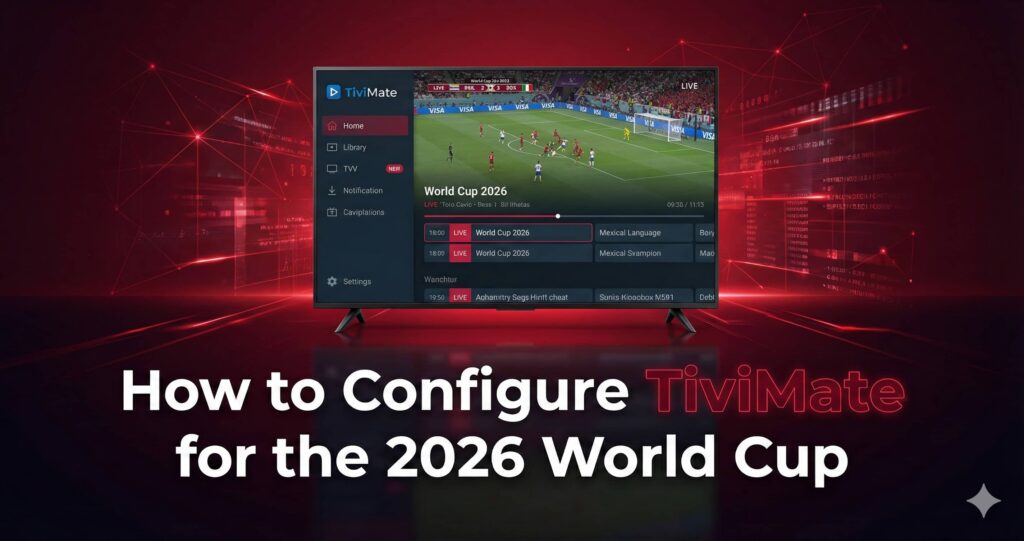
As the 2026 World Cup approaches, the excitement for 48 teams competing across North America is reaching a fever pitch. To experience every minute in stunning 4K without the clunky interface of traditional cable, TiviMate has established itself as the premier IPTV player of 2026. Known for its “broadcast-style” feel and advanced multi-screen capabilities, TiviMate is the ultimate tool for a professional sports setup. This educational guide provides a technical, step-by-step walkthrough on how to install, activate, and optimize TiviMate specifically for the 2026 World Cup. Whether you are a seasoned user or a newcomer, these settings will ensure you never miss a goal due to technical lag. Step 1: Installation and Initial Setup TiviMate is designed for Android-based systems (Android TV, Google TV, and Amazon Firestick). Because it is a “player-only” application, the first step is getting the software onto your device. For Android TV/Google TV: Open the Google Play Store, search for “TiviMate IPTV Player,” and click install. For Amazon Firestick: Since TiviMate isn’t always in the Amazon Appstore, use the Downloader app. Enter the official TiviMate shortcode (e.g., 272483) to download the latest 2026 APK and follow the prompts to install. Step 2: Unlocking Premium Features While TiviMate has a free version, the features required for a world-class World Cup experience—such as Multi-view and Scheduled Recording—require the Premium version. In 2026, a lifetime subscription covers up to 5 devices, making it a highly cost-effective investment. Open TiviMate and navigate to Settings > Unlock Premium. If you are on a Firestick, you must use the TiviMate Companion app on an Android smartphone or a PC emulator (like BlueStacks) to process the payment. Once purchased, log in with your account details on your TV to activate the premium features instantly. Step 3: Integrating Your World Cup Playlist To populate the app with channels, you need to add your service details. We recommend using the Xtream Codes API method for the 2026 World Cup because it handles large channel lists and EPG (Electronic Program Guide) data more efficiently than standard M3U links. Go to Settings > Playlists > Add Playlist. Select Xtream Codes. Enter your Server URL, Username, and Password provided by your service. Click Next and let TiviMate process the channels and VOD library. Step 4: Creating a “World Cup 2026” Favorites Group With thousands of global channels, finding the right match can be overwhelming. TiviMate allows you to create custom groups to keep your eyes on the ball. While on the TV Guide, long-press the Select button on a channel that will broadcast the World Cup (e.g., FOX, Telemundo, BBC, or beIN Sports). Select “Add to Favorites.” You can then go to Settings > Appearance > TV Guide and ensure your “Favorites” group is at the very top of the list for quick access during match days. Step 5: Master the Multi-View Feature The 2026 group stage will feature multiple concurrent matches. TiviMate Premium allows you to watch up to 9 screens at once (though 2-4 is recommended for most 4K devices). While watching a live match, press the Select button to bring up the bottom menu. Scroll down and select Multi-view. Select “Add Screen” and choose your second World Cup channel. You can toggle the audio between screens by simply navigating with your remote’s directional pad. Step 6: Optimizing for 4K Performance To ensure a buffer-free 2026 World Cup, you must tune TiviMate’s internal engine to match your network speed. Recommended Technical Settings: Buffer Size: Navigate to Settings > Playlists > [Your Playlist] > Buffer Size. If you have fiber internet (100Mbps+), set this to “None” for instant zapping. If you are on Wi-Fi, set it to “Small” (1-2 seconds). Audio Passthrough: Enable this in Settings > Player to get the full stadium atmosphere if you have a surround sound system. AFR (Auto Frame Rate): Turn this ON. This allows TiviMate to match your TV’s refresh rate to the broadcast (e.g., 50Hz for European channels or 60Hz for US channels), eliminating “motion judder.” Step 7: Setting Up Scheduled Recordings Since the 2026 games are hosted in North America, fans in different time zones may need to record matches. TiviMate makes this easy, but it requires a storage location. Go to Settings > Other > Recording. You can set up a path to a USB drive (via an OTG cable on Firesticks) or a Network Attached Storage (NAS). Once set, simply find the match in the EPG, long-press, and select “Schedule Recording.” TiviMate will handle the rest, even if the app is closed. Conclusion: Your Stadium in the Living Room By following this guide, you have transformed TiviMate from a simple player into a professional-grade broadcasting hub for the 2026 World Cup. With Multi-view ready, 4K settings optimized, and your favorites organized, you are prepared for the most immersive football tournament in history. Keep your EPG updated, ensure your internet connection remains stable, and enjoy the beautiful game like never before, visit IPTV world cup 2026. Need more help? Check our other articles on the best hardware for 2026 and how to eliminate buffering forever.

Best 4K Streaming Devices for World Cup 2026
World Cup 2026 Streaming Guides & News

Best 4K Streaming Devices for World Cup 2026: Firestick vs. NVIDIA Shield vs. Apple TV

With the 2026 World Cup arriving in North America, the demand for high-performance streaming has never been higher. For fans, the choice of hardware is just as important as the service they use. A slow processor or a weak Wi-Fi chip can mean the difference between a crystal-clear goal and a pixelated mess. In this educational breakdown, we compare the “Big Three” of the streaming world: the Amazon Fire TV Stick 4K Max, the NVIDIA Shield TV Pro, and the Apple TV 4K (2025/2026 Edition). By 2026, streaming technology has evolved to handle higher bitrates and lower latencies. However, each of these devices approaches the “Perfect Match Day” differently. Whether you prioritize AI-enhanced visuals, ecosystem integration, or raw value for money, this guide will help you choose the right engine for your World Cup experience. 1. The Powerhouse: NVIDIA Shield TV Pro Even in 2026, the NVIDIA Shield TV Pro remains the undisputed king for power users and IPTV enthusiasts. While its industrial design has remained consistent, its internal architecture is built for one thing: performance. AI-Enhanced Upscaling: The Secret Weapon The standout feature for World Cup fans is NVIDIA’s AI Upscaling. Many live sports broadcasts are still delivered in 1080p or even 720p to save bandwidth. The Shield Pro uses its Tegra X1+ processor and trained neural networks to upscale these lower-resolution signals to near-4K quality in real-time. This results in sharper player jerseys, clearer grass textures, and more readable scoreboard text. Connectivity and Storage Unlike “stick” devices, the Shield Pro features a Gigabit Ethernet port. For a tournament as big as the World Cup, a wired connection is the best way to eliminate jitter. It also boasts two USB 3.0 ports, allowing you to connect external hard drives for recording matches or expanding the device’s internal 16GB storage. Best For: Users who want the absolute best picture quality for non-4K channels and those who plan to record games. Operating System: Android TV (highly customizable for IPTV players like TiviMate). 2. The Seamless Experience: Apple TV 4K (2025/2026) Apple’s latest iteration of its streaming box is built around the A17 Pro (or A18) chip, making it arguably the fastest streaming device on the planet. For the 2026 World Cup, Apple has focused on stability and the “Instant-On” experience. Fluidity and Interface The tvOS interface is famous for being ad-free and incredibly smooth. When flipping between matches, the Apple TV 4K shows zero lag. Its QMS (Quick Media Switching) technology ensures that when the frame rate changes from a 60fps match to a 24fps documentary, your TV doesn’t “black out” for a few seconds. The Ecosystem Advantage If you own an iPhone or AirPods, the experience is unmatched. You can use your iPhone to calibrate the color balance of your TV for the pitch, and if you need to watch a late-night match without waking the family, Spatial Audio on AirPods provides a stadium-like experience in your ears. Best For: Apple users who want a premium, ad-free experience and the most stable apps in the industry. Operating System: tvOS (extremely secure, though slightly more restricted for “sideloading” compared to Android). 3. The Value Champion: Amazon Fire TV Stick 4K Max The Fire TV Stick 4K Max (2nd Gen/2026 refresh) is designed to bring 4K streaming to the masses. It is a “stick” that hides behind your TV but packs a surprising amount of punch for its price point. Wi-Fi 6E Support One of the biggest hurdles during a global event like the World Cup is wireless congestion. The 4K Max supports Wi-Fi 6E, which utilizes the 6GHz band. This is like having a “private lane” on the highway for your data, significantly reducing buffering caused by other devices in your home. Portability and Integration The Firestick is the perfect travel companion. If you are visiting friends for a World Cup viewing party, you can simply plug it into their guest HDMI port. It also features Live TV Integration, allowing World Cup channels to show up directly in your “Recents” row on the home screen. Best For: Budget-conscious fans who want 4K HDR and Wi-Fi 6E without the high price tag of a dedicated box. Operating System: Fire OS (Android-based, very easy to install IPTV applications). Technical Comparison Table Feature NVIDIA Shield Pro Apple TV 4K Fire TV Stick 4K Max Processor Tegra X1+ (AI Focus) A17 Pro / A18 Quad-Core 2.0 GHz RAM 3 GB 4 GB – 8 GB 2 GB Storage 16 GB (Expandable) 64 GB / 128 GB 16 GB Ethernet Built-in Gigabit Built-in Gigabit Requires Adapter Wireless Wi-Fi 5 (AC) Wi-Fi 6 / 6E Wi-Fi 6E Special Feature AI Upscaling Apple Ecosystem / QMS Portability / Low Price 4. Hardware Performance in Live Sports Scenarios When watching a fast-paced sport like football, “Judder” and “Motion Blur” are the enemies. Let’s look at how these devices handle the 2026 World Cup feed: Frame Rate Matching The World Cup is broadcast in different frame rates depending on the region (50Hz in Europe, 60Hz in the US). Apple TV 4K has the most robust system-wide frame rate matching. It forces your TV to match the broadcast, ensuring the ball moves smoothly across the screen. NVIDIA Shield and Firestick also offer this, but it often requires manual setup within specific apps like TiviMate. Thermal Throttling Cheap streaming sticks often overheat during long 4K sessions, causing them to slow down and buffer. The NVIDIA Shield Pro and Apple TV 4K have superior thermal management (the Shield even has a tiny, silent fan). If you plan to watch three matches in a row on a hot summer day, these boxes are far more reliable than a small stick tucked behind a hot TV panel. 5. Software Ecosystems for 2026 The 2026 landscape is divided into three distinct software philosophies: Android TV (Shield): Open and flexible. It allows for advanced networking apps, custom launchers, and detailed system monitoring. Fire OS (Amazon): Very aggressive with advertisements but very fast at launching Amazon-hosted content.

Why IPTV is the Future of Live Sports in 2026
World Cup 2026 Streaming Guides & News

Why IPTV is the Future of Live Sports in 2026

As we stand on the precipice of the 2026 World Cup, the way the world consumes sports is undergoing its most radical transformation since the invention of the satellite dish. Traditional cable and satellite television, once the undisputed kings of the living room, are rapidly losing ground to a more flexible, powerful, and cost-effective successor: Internet Protocol Television (IPTV). By 2026, IPTV has moved from a niche technology used by early adopters to a mainstream powerhouse capable of delivering 4K and 8K resolution, real-time statistics, and multi-angle viewing. For fans preparing for the biggest World Cup in history—spanning the USA, Canada, and Mexico—understanding why IPTV is the superior choice is no longer optional; it is the key to the ultimate viewing experience. The Technological Shift: From Broadcast to Bitrate To understand why IPTV is the future, we must first understand how it differs from traditional broadcasting. Traditional TV sends signals via radio waves (terrestrial), fiber-optic cables, or satellite beams. These signals are “pushed” to everyone at the same time, regardless of whether they are watching. This is a one-way, rigid system. IPTV, however, operates on a “pull” mechanism. It uses the same internet protocols that power the web to deliver video packets. This fundamental difference allows for two-way communication, enabling the interactivity that sports fans now crave. In 2026, with the widespread adoption of 5G networks and Wi-Fi 7, the infrastructure is finally strong enough to support the massive bitrates required for live, high-action football without the lag that plagued earlier streaming attempts. 1. Unmatched Visual Fidelity: 4K, 8K, and HDR The World Cup 2026 is expected to be a showcase for ultra-high-definition broadcasting. While many cable providers still struggle to offer more than a handful of 4K channels due to bandwidth limitations on their physical lines, IPTV is limited only by your internet speed. Higher Bitrates: High-quality IPTV providers in 2026 offer bitrates of 25 Mbps to 50 Mbps for 4K streams. This results in less compression, meaning the green of the pitch is sharper, and the motion of the ball is fluid. High Dynamic Range (HDR): IPTV easily supports HDR10+ and Dolby Vision, which provide better contrast and more realistic colors. When a match moves from a sunny part of the stadium to a shadowed area, HDR ensures you don’t lose detail. Future-Proofing with 8K: Leading IPTV infrastructures are already testing 8K streams for the 2026 final, offering four times the detail of 4K—something traditional cable likely won’t achieve for another decade. 2. The End of “One-Size-Fits-All” Viewing One of the most significant reasons IPTV is dominating the 2026 sports landscape is personalization. In the past, you saw exactly what the director in the broadcast truck wanted you to see. With advanced IPTV players and services, the viewer is now the director. Multi-View and Picture-in-Picture The 2026 World Cup features 48 teams, meaning more concurrent matches during the group stages. IPTV allows for “Multi-View” features where you can watch up to four matches simultaneously on one screen. This is a game-changer for fans who want to keep an eye on their home team while monitoring their group rivals. Real-Time Statistical Overlays Modern IPTV services integrate with live data providers. As you watch the match, you can toggle an overlay that shows player heat maps, sprint speeds, passing accuracy, and “Expected Goals” (xG) in real-time. This interactive layer is something traditional broadcast signals simply cannot handle natively. 3. Economic Disruption: Value for the Modern Fan The economics of sports broadcasting have become increasingly fragmented. To watch every game in a traditional setup, fans often need multiple expensive cable packages and premium add-ons. IPTV consolidates this into a single, affordable ecosystem. Feature Traditional Cable (2026) Premium IPTV (2026) Average Monthly Cost $120 – $200 $15 – $30 Channel Selection Regional/Limited Global (20,000+ Channels) Contract Requirement Often 12-24 Months No Contract/Monthly Hardware Proprietary Box (Rental) Universal (Firestick, Shield, Mobile) As shown above, the cost-to-value ratio for IPTV is significantly higher. For the price of a single stadium ticket, a fan can secure a year of global sports access, including every match of the 2026 World Cup from broadcasters around the world. 4. Mobility and the “Always-On” Fan The World Cup 2026 will be hosted across North America, meaning matches will take place at times that may not align with the working day in Europe, Africa, or Asia. IPTV solves the “time-zone problem” through its inherent mobility and time-shifting features. Cloud DVR & Catch-Up: If a match starts at 3:00 AM in your time zone, IPTV services allow you to “Catch-Up” by accessing a recorded version immediately after the game ends—or even while it’s still in progress. Multi-Device Syncing: You can start watching a match on your Smart TV at home, continue on your smartphone during your commute, and finish on your tablet at a cafe. The stream follows you, not the other way around. 5. Solving the Latency Problem (The “Spoiler” Fix) A common criticism of early streaming was that it was 30-60 seconds behind the live action. In 2026, technology has effectively solved this. Through the use of LL-HLS (Low Latency HTTP Live Streaming) and UDP (User Datagram Protocol) delivery, IPTV latency has been reduced to under 5 seconds—comparable to, and sometimes faster than, traditional satellite signals. This means fans no longer have to worry about hearing their neighbors cheer for a goal before they see it on their own screen. This technical milestone is a major reason why major sports leagues are now signing multi-billion dollar exclusive deals with streaming-first platforms. 6. Global Access vs. Geo-Restrictions Traditional broadcasters are often limited by geographic boundaries. If you are an expat living in a country where your national team’s matches aren’t being shown, you are traditionally out of luck. IPTV provides a global bridge. By offering channels from every continent, fans can watch the specific commentary and coverage of their home country, regardless of where they are physically located during the tournament. Technical Requirements for the 2026 World Cup To

The Ultimate IPTV Setup Guide for World Cup 2026
World Cup 2026 Streaming Guides & News

The Ultimate IPTV Setup Guide for World Cup 2026

Optimize Your Streaming Experience for the Biggest Event in Sports The 2026 World Cup is set to be the most-watched sporting event in history. With matches spread across three time zones and dozens of cities, ensuring your home entertainment system is ready for high-definition streaming is essential. This guide provides a technical walkthrough on how to configure IPTV for maximum performance during the tournament. Essential Hardware for 4K Playback To handle the high frame rates (60fps) required for smooth football motion, your hardware needs sufficient processing power. Below are the top-tier devices recommended for 2026: Device Category Recommended Hardware Key Benefit Streaming Devices Amazon Fire TV Stick 4K Max / Apple TV 4K Dedicated hardware decoding for 4K streams. Android Boxes NVIDIA Shield TV Pro Superior AI upscaling for non-HD channels. Smart TVs Google TV / LG webOS Integrated experience without external cables. Network Optimization Strategies Live sports are sensitive to latency and jitter. To ensure you don’t see a “loading” circle right before a goal, follow these networking protocols: Hardwire via Ethernet: Wi-Fi is prone to interference. A Cat6 Ethernet cable ensures a consistent 100Mbps+ connection. 5GHz Band Usage: If you must use Wi-Fi, ensure your device is connected to the 5GHz band rather than 2.4GHz to avoid congestion from other household electronics. Quality of Service (QoS): Access your router settings and prioritize traffic to your streaming device to ensure it gets the most bandwidth during match times. Pro Tip: A stable download speed of at least 25 Mbps is required for a single 4K stream. For households with multiple users, aim for 100 Mbps or higher. Step-by-Step Software Configuration Once your hardware and network are ready, follow these steps to configure your chosen player application: 1. Select a Media Player For the best user experience, choose a player that supports EPG (Electronic Program Guide) and multi-screen viewing. Popular choices include TiviMate, IPTV Smarters Pro, and OTT Navigator. 2. Input Connection Details Most services utilize one of two connection methods: M3U URL: A link that imports the entire channel list. Xtream Codes API: Requires a Server URL, Username, and Password (generally faster to load). 3. Configure the EPG (Program Guide) Ensure your EPG source is updated. This allows you to see the 2026 World Cup schedule directly in your interface, set reminders for matches, and even record games if your app supports local storage. Advanced Tuning for Live Sports To get the most out of your stream, dive into the advanced settings of your player app: Buffer Size: Set your buffer to “Small” (0.5s – 1s). This reduces the delay between the real-life action and your screen, ensuring you aren’t spoiled by crowd noise from neighbors. Hardware Acceleration: Enable “Hardware Decoding” in settings to let the device’s GPU handle the video processing, reducing heat and lag. Refresh Rate Switching: Enable “Auto Frame Rate” (AFR). This matches your TV’s refresh rate to the broadcast (e.g., 50Hz or 60Hz), eliminating motion judder. Enjoy the 2026 World Cup with the best possible visual experience. Prepare your setup today to avoid last-minute technical hurdles.

Scroll to Top