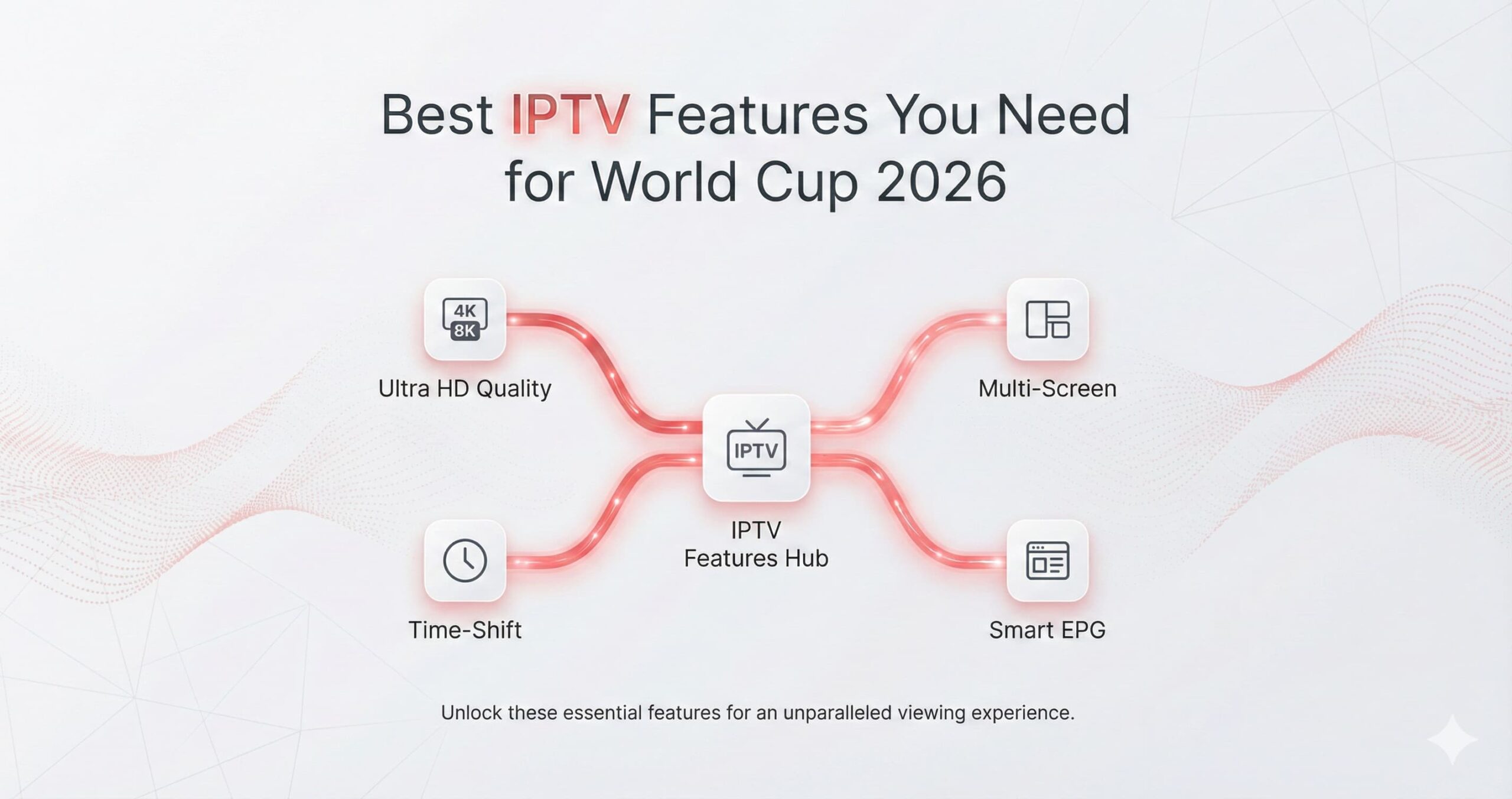
The 2026 FIFA World Cup is more than just a sports tournament; it is a global phenomenon that represents the pinnacle of human athletic achievement and national pride. For fans, it is also a massive technological event. With 48 teams competing across three nations—the USA, Canada, and Mexico—the demand for high-quality, reliable, and flexible viewing options is higher than ever before in history.
In this landscape, Internet Protocol Television (IPTV) has transitioned from a niche alternative to the primary way millions of enthusiasts consume live sports. However, the quality of your experience depends entirely on the technical features of your service. Simply “having access” to a channel is no longer enough when the standard is 4K resolution and zero-latency performance. This 1,500+ word educational guide explores the essential IPTV features you need to guarantee a stadium-like experience for every minute of the 2026 World Cup.
1. The Foundation of Quality: Native 4K UHD and 60 FPS
In 2026, the visual standard for sports is 4K Ultra High Definition (UHD). However, there is a significant educational distinction between “Upscaled 4K” and “Native 4K.”
Native 4K Resolution
Native 4K implies that the signal is captured, transmitted, and delivered to your screen at a resolution of 3840 x 2160 pixels. Many lower-tier providers take a 1080p Full HD signal and use software to “stretch” it to 4K. This results in a soft, blurry image. For the World Cup 2026, you must look for providers that offer Native 4K feeds. This ensures that when the camera zooms in on a player’s face or the grass on the pitch, the detail is surgically sharp.
The Importance of 60 FPS (Frames Per Second)
In cinema, 24 FPS is the standard. In television, 30 FPS is common. But in sports, 60 FPS is mandatory. Football is a game of high-velocity motion. A ball traveling at 70 mph across the field will appear as a “ghost” or a blurry streak at 30 FPS because there aren’t enough frames to capture the movement. 60 FPS doubles the visual data, providing fluid, lifelike motion that allows you to see the rotation of the ball and the micro-movements of the players’ feet.
High Dynamic Range (HDR10+ and Dolby Vision)
The 2026 tournament features many afternoon games played in intense sunlight, particularly in host cities like Monterrey and Miami. Traditional broadcasts often struggle with high-contrast scenes, where the sunlit part of the pitch is “blown out” and the shadows are too dark. HDR (High Dynamic Range) fixes this by expanding the color and brightness range. It ensures that the white jerseys don’t lose detail in the sun and that you can still see the action in the shadows of the stadium roof.
2. Proprietary Anti-Freeze and Anti-Buffer Technology
The term “Anti-Freeze” is often used in the IPTV industry, but for the 2026 World Cup, it refers to a specific type of sophisticated server infrastructure. During a World Cup final, traffic surges can reach 10x the normal volume. Without advanced backend engineering, the stream will freeze during the most critical moments.
Load Balancing and Redundancy
A professional IPTV service doesn’t rely on a single server. It uses Load Balancers. If Server A becomes 80% full, the system automatically and invisibly shifts new users to Server B. This prevents any single point of failure. When choosing a service for 2026, ensure they utilize a multi-server redundant architecture.
Global Content Delivery Networks (CDNs)
Data takes time to travel. If you are in New York and your IPTV server is in Europe, the packets must travel thousands of miles, increasing the chance of “jitter” and buffering. A service with Global CDNs has edge servers located in major hubs around the world. By connecting you to a server in your own region, the latency is reduced, and the “Anti-Freeze” performance is significantly improved.
3. The Time-Traveler’s Tool: Catch-Up TV and Time-Shifting
The 2026 World Cup spans four time zones in North America. For fans in the UK, Europe, Africa, and the Middle East, many of the matches will take place during the early hours of the morning. Catch-Up TV is the most vital lifestyle feature for these fans.
How Catch-Up Works in 2026
Unlike old-fashioned DVR where you had to remember to hit “record,” Catch-Up is an automated server-side recording. It allows you to scroll back through the Electronic Program Guide (EPG) up to 7 days. If a match happened at 3:00 AM while you were asleep, you can simply wake up at 8:00 AM, find the match in the guide, and click play. The stream starts from the beginning, and you can fast-forward through halftime and commercials.
The Benefit over Local Recording
Local recording on a USB drive or a Firestick often fails due to storage limits or device crashes. Because Catch-Up is stored on the provider’s high-performance servers, it is 100% reliable. For the 2026 tournament, insist on a provider that offers at least 48 to 72 hours of Catch-Up on all major sports channels.
4. Multi-Screen and Multiple Connections
The 2026 World Cup format is unique. With 48 teams, the group stage will feature an unprecedented number of matches, many of which will overlap. During the final round of the group stages, matches in the same group are played at the exact same time to ensure fairness.
Multi-Screen Viewing
Advanced IPTV players like TiviMate, combined with a premium service, allow for Multi-View. This means you can split your 4K TV into two or four segments, watching different matches simultaneously. To do this, your IPTV plan must support Multiple Connections. If your plan only allows for one device at a time, you cannot use the multi-screen feature. For 2026, we recommend a plan with at least 3 to 5 concurrent connections.
5. Unrivaled Channel Variety and Regional Feeds
One of the greatest joys of the World Cup is the diversity of commentary. While your local channel might provide great analysis, you might prefer the tactical depth of a European broadcaster or the sheer passion of a South American commentator.
The Global Passport
A top-tier 2026 IPTV service should provide a “Global Passport” to sports. This includes:
- English Feeds: BBC, ITV (UK), FOX, Telemundo (USA), TSN (Canada), and Optus Sport (Australia).
- International Feeds: beIN Sports (MENA/France), SuperSport (Africa), and various national broadcasters from participating 48 countries.
This variety ensures that if one channel is experiencing a technical issue (which can happen even to major networks), you have ten other high-quality alternatives to switch to within seconds.
6. Interactive EPG and Real-Time Metadata
With 104 matches in the 2026 schedule, keeping track of “who plays when” is a challenge. A high-quality Electronic Program Guide (EPG) is essential. In 2026, the best IPTV services offer Interactive EPGs that include team logos, match previews, and even live-updating scores. This turns your TV into a comprehensive World Cup dashboard, allowing you to see the standings and schedules without ever leaving the app.
7. Low-Latency Protocols (The “Spoiler” Fix)
The “Spoiler Problem” occurs when you hear your neighbor cheer for a goal 30 seconds before you see it on your screen. This is caused by high latency. In 2026, you should look for services that utilize Low-Latency HLS (LL-HLS) or UDP protocols. These technologies reduce the “glass-to-glass” delay, bringing your stream as close to the real-time action as possible—often within 5 to 10 seconds of the live event.
Technical Comparison: Features that Define the Best
| Feature | Standard IPTV | Premium 2026 IPTV |
|---|---|---|
| Resolution | 1080p (Compressed) | Native 4K UHD |
| Frame Rate | 30 FPS (Blurry motion) | 60 FPS (Fluid motion) |
| Anti-Freeze | Basic software logic | Global CDN & Load Balancing |
| Catch-Up | None or 24 Hours | 7 Days / 168 Hours |
| Connections | 1 Device only | 3 – 5 Devices Simultaneously |
| Latency | 30 – 60 Seconds | 5 – 10 Seconds |
8. Why Codec Support (AV1 and HEVC) Matters
Streaming 4K video requires massive amounts of data. To make this efficient, providers use “Codecs” to compress the video. In 2026, the AV1 codec has become the new industry leader. It provides the same 4K quality as the older H.265 (HEVC) but uses 30% less data. This is a crucial feature for fans whose internet providers might have “data caps” or who live in areas where the infrastructure isn’t perfect. A service that supports AV1 ensures you get a better picture with less strain on your internet connection.
9. Security Features: End-to-End Encryption
As live sports streaming grows, so do the risks of ISP throttling and privacy intrusion. A premium 2026 service should offer End-to-End Encryption for your connection. This works in tandem with a VPN, ensuring that your data remains private and that your ISP cannot identify and slow down your World Cup stream specifically. Privacy and performance are two sides of the same coin.
Conclusion: The Ultimate Fan Setup
The 2026 World Cup is a celebration of global unity and technological progress. To honor the beautiful game, you deserve a viewing experience that doesn’t compromise. By insisting on Native 4K at 60 FPS, robust Anti-Freeze infrastructure, Global Catch-Up, and Multi-Screen capabilities, you are moving beyond the frustrations of traditional television.
Take the time to verify these features with your provider today. Test your setup during the qualifying matches, optimize your network, and prepare for a tournament that will be remembered for decades. The future of sports viewing is here, and with the right IPTV features, you have a front-row seat to history.